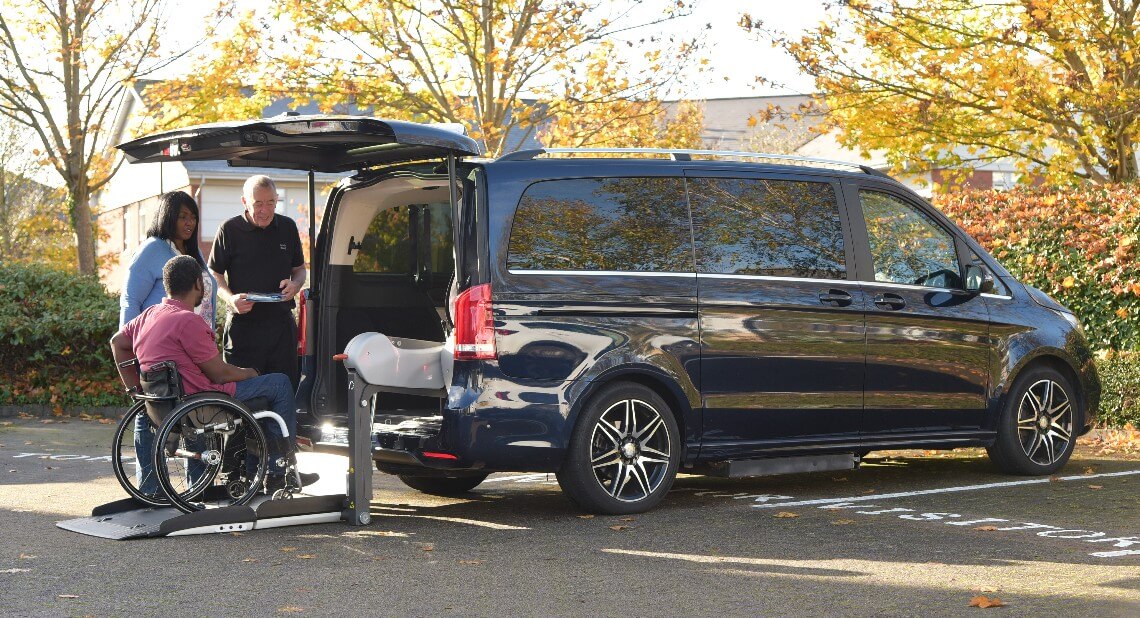
But these issues are not just limited to new cars. Wheelchair Accessible Vehicles (WAVWheelchair Accessible Vehicles) are also being impacted, so we wanted to explain what is happening, what this means for WAVWheelchair Accessible Vehicles on the Scheme and what we’re doing to help.
Supply challenges
Vehicle supply has now been impacted for more than a year due to a variety of factors including COVID-19 and a shortage of semiconductors, or ‘chips’, brought on by high demand for electrical items during the pandemic.
Previously, many WAVWheelchair Accessible Vehicle converters would have vehicles in stock ready to convert when you place your order, or even have a selection of pre-converted vehicles ready to collect in just a week or two.
However, most of this available stock has now been used. This means that when you place an order, converters are generally having to order the vehicle from the manufacturer before they can start to convert it.
Most manufacturers are working through a large backlog of orders, and this means vehicles are taking a long time to be delivered. In many cases, manufacturers are unable to provide a reliable date for when the vehicle may be built and delivered to the converter. These challenges are expected to continue for the foreseeable future.
On top of this, many WAVWheelchair Accessible Vehicles are based on larger vehicles or vans. It is often quicker for manufacturers to build and sell these as commercial vehicles, or ‘panel vans’, rather than passenger vehicles with rear seats and windows. This is because fewer parts are needed to build the vehicle interior, and fewer semiconductors to work features such as electric rear windows. However, commercial vehicles without rear windows are not suitable to be converted into WAVWheelchair Accessible Vehicles.
Manufacturing costs
As well as supply delays, manufacturers and converters are dealing with increased costs to build and convert WAVWheelchair Accessible Vehicles. These processes use a lot of energy which is now costing more than it did in recent years, and many of the raw materials needed to build and convert the vehicle have also increased in price.
This means that vehicles are becoming more expensive to purchase from the manufacturers, and more expensive for converters to turn in to WAVWheelchair Accessible Vehicles, which has led to an increase in the Advance Payment for many WAVWheelchair Accessible Vehicles on the Scheme.
As Conor McElmeel, Chairman of the Wheelchair Accessible Vehicle Converters Association (WAVWheelchair Accessible VehicleCA), explains:
“ The challenges currently faced by our industry are unprecedented. The Motability Scheme and WAVWheelchair Accessible VehicleCA has sought to insulate customers from this for as long as we could, but as prices of vehicles continue to increase, we are no longer able to do so to the extent we would like. Coupled with the spiralling costs of raw materials and energy, it’s almost the perfect storm. We’re meeting with manufacturers regularly to try and find a sustainable solution and will continue to do so to until we find the right answers.”
What we’re doing to help
To help improve the supply of WAVWheelchair Accessible Vehicles on the Scheme, we’ve recently changed our rules around Nearly New WAVWheelchair Accessible Vehicles to make more of these vehicles available.
Nearly New WAVWheelchair Accessible Vehicles are vehicles that have been given back to us early in good condition by another WAVWheelchair Accessible Vehicle customer. They are available on a three-year lease and have a much lower Advance Payment than new WAVWheelchair Accessible Vehicles.
Previously, WAVWheelchair Accessible Vehicles could only be leased as Nearly New WAVWheelchair Accessible Vehicles if they were returned to us before they were three years old. However, we’ve now extended this to four years to make more vehicles available.
As these vehicles do not need to be manufactured or converted, they can generally be supplied in just a few weeks. However, they are always subject to availability, depending on what has been handed back by other customers.
If you’re interested in leasing a Nearly New WAVWheelchair Accessible Vehicle, you can find out more here or speak to a converter to see what they have in stock.
Keeping you mobile
If you’re an existing customer and you’re unable to find a suitable new WAVWheelchair Accessible Vehicle to order by the end of your current lease, we’ll automatically extend your lease for six months to give you more time.
You can place an order at any point during your lease extension, and once you’ve ordered a new vehicle, we’ll extend your lease for as long as needed until your new WAVWheelchair Accessible Vehicle arrives.
Related articles
Vehicle supply issues and delayed orders: your questions answered
How global supply problems are affecting the vehicle repair industry